Running a business by yourself means doing a little bit of everything.
You might be the marketer, content creator, designer, email manager, salesperson, and customer support team — all on the same day.
The good news is that you don’t need an expensive software stack to get started.
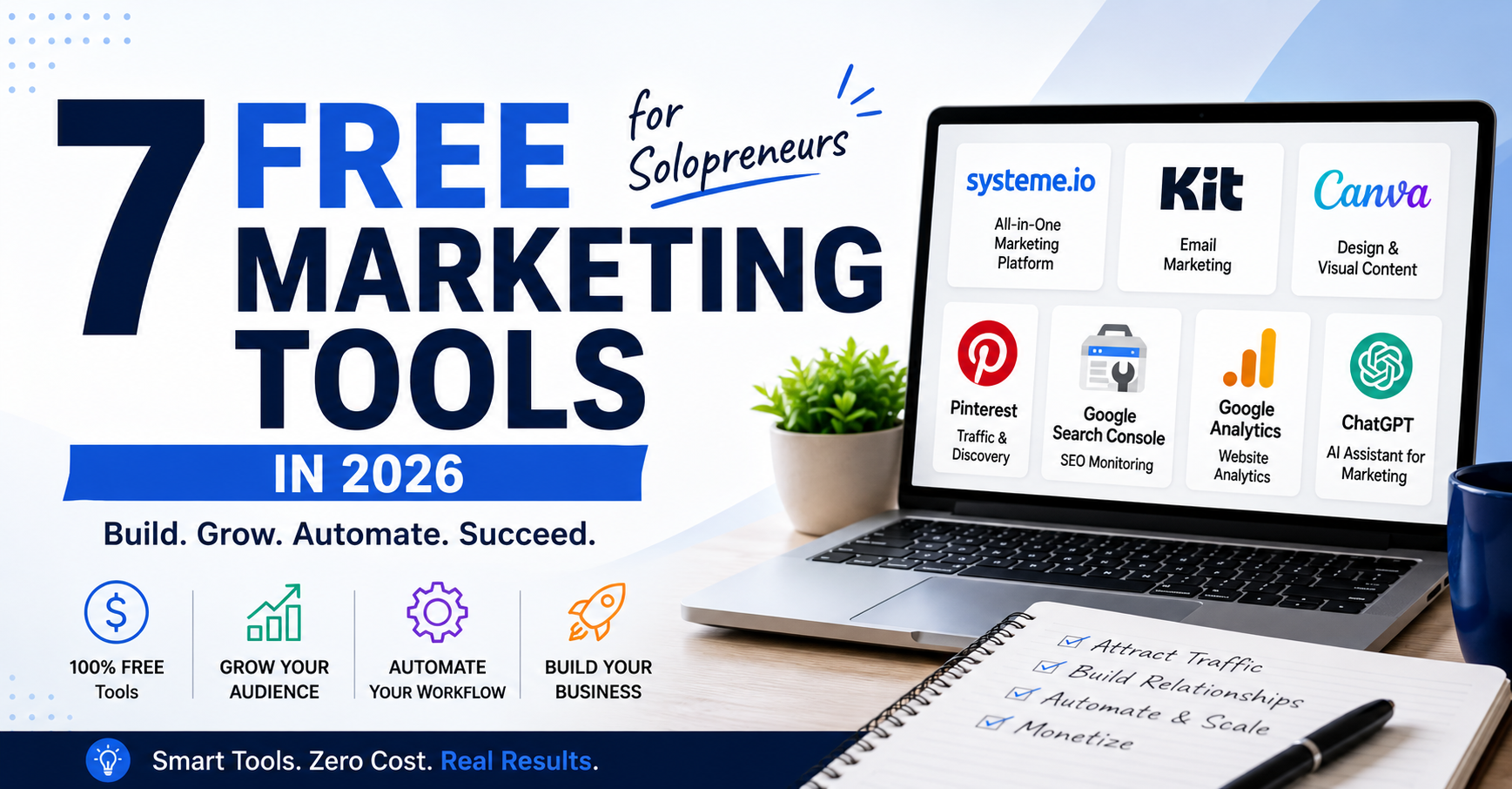
In 2026, there are excellent free marketing tools that can help solopreneurs build websites, grow email lists, create content, attract traffic, and automate repetitive tasks.
In this guide, I’ve selected seven tools that can cover most of the basic marketing needs of a new solo business.
Some are completely free, while others use free plans with paid upgrades as your business grows.
Affiliate disclosure: This article contains affiliate links. If you sign up through one of these links, I may earn a commission at no additional cost to you. I personally tested Systeme.io’s free plan. Other tools in this guide were evaluated using their current official product information and documentation.
- Best Free Marketing Tools for Solopreneurs: Quick Comparison
- 1. Systeme.io — Best Free All-in-One Marketing Platform
- 2. Kit — Best Free Email Marketing Tool for Creators
- 3. Canva — Best Free Design Tool
- 4. Pinterest — Best Free Visual Discovery Channel
- 5. Google Search Console — Best Free SEO Monitoring Tool
- 6. Google Analytics — Best Free Website Analytics Tool
- 7. ChatGPT — Best Free AI Marketing Assistant
- What Is the Best Free Marketing Stack?
- Systeme.io vs Kit: Which Should You Start With?
- Don’t Pay for Tools Before You Need Them
- Final Verdict
Best Free Marketing Tools for Solopreneurs: Quick Comparison
| Tool | Best For | Free Option |
|---|---|---|
| Systeme.io | All-in-one marketing | Yes |
| Kit | Email marketing | Yes |
| Canva | Graphics and visual content | Yes |
| Organic discovery | Yes | |
| Google Search Console | SEO monitoring | Yes |
| Google Analytics | Website analytics | Yes |
| ChatGPT | Content and marketing assistance | Yes |
You don’t necessarily need all seven.
The right stack depends on where your customers come from and how you plan to monetize your business.
Let’s look at each tool.
1. Systeme.io — Best Free All-in-One Marketing Platform
Best for: Solopreneurs who want websites, funnels, email marketing, automation, and products in one place.
Systeme.io is one of the most interesting options for someone trying to build an online business without connecting several different marketing platforms.
Its Free plan currently supports up to 2,000 contacts, three sales funnels, one blog, one course, one custom domain, and unlimited email sends.
The platform includes tools for:
- Sales funnels
- Email marketing
- Websites and blogs
- Marketing automation
- Online courses
- Products
- Affiliate management
I tested the free plan while researching my full Systeme.io review.
The website builder allowed me to create and edit a basic creator website visually without writing code.
The main limitation I encountered was during email setup: using my own sender domain required domain authentication, which adds an extra configuration step.
Still, the ability to put several important marketing functions under one account makes Systeme.io particularly useful for a solo business.
Systeme.io Pros
- Generous permanent Free plan
- Website and funnel builder
- Unlimited email sends
- Basic automation
- Course functionality
- No credit card required for Free
Systeme.io Cons
- Free plan has usage limits
- Email domain setup can require DNS configuration
- Specialists may prefer dedicated tools for individual functions
Best choice if: You want to minimize the number of different platforms you need to manage.
Read my Systeme.io Review (2026)
2. Kit — Best Free Email Marketing Tool for Creators
Best for: Creators who want to build an email audience.
Kit — formerly ConvertKit — focuses heavily on creators and email marketing.
Its current Free plan supports up to 10,000 subscribers and includes unlimited landing pages and forms, unlimited email broadcasts, audience tagging and segmentation, and the ability to sell digital products and subscriptions.
That makes the free tier especially attractive for newsletter-first businesses.
Kit is useful for:
- Newsletters
- Email broadcasts
- Subscriber management
- Landing pages
- Signup forms
- Audience segmentation
- Digital products
More advanced features such as unlimited visual automations and email sequences are part of Kit’s paid plans.
Kit Pros
- Up to 10,000 subscribers on Free
- Unlimited broadcasts
- Unlimited forms and landing pages
- Built specifically around creators
- Digital product support
Kit Cons
- Advanced automation requires a paid plan
- Less of an all-in-one business platform than Systeme.io
Best choice if: Your email list or newsletter is the center of your business.
I’ve compared the two approaches in more detail here:
Systeme.io vs Kit (2026): Which Is Better for Creators?
3. Canva — Best Free Design Tool
Best for: Creating marketing graphics without professional design software.
Most solopreneurs need graphics eventually.
That might mean:
- Pinterest Pins
- Blog graphics
- Social posts
- Lead magnets
- Presentations
- Simple branding assets
- Product graphics
Canva’s Free plan provides a drag-and-drop editor, a large library of templates and media, 5GB of cloud storage, and limited AI usage.
For someone who isn’t a professional designer, the biggest advantage is speed.
You can start with a template instead of designing every asset from a blank canvas.
Canva Pros
- Beginner friendly
- Large template library
- Useful across multiple marketing channels
- Free plan is enough for many basic designs
Canva Cons
- Some premium assets and tools require Canva Pro
- Popular templates can make designs look similar if you don’t customize them
Best choice if: You regularly need graphics but don’t want to learn complex design software.
4. Pinterest — Best Free Visual Discovery Channel
Best for: Content businesses with visually searchable topics.
Pinterest is different from a traditional social feed.
Users often use the platform to discover ideas, guides, products, and resources.
That can make it interesting for niches such as:
- Online business
- Blogging
- Marketing
- Productivity
- Design
- Creator tools
- Education
For a solopreneur publishing articles, one useful strategy is to create multiple Pins that point to the same piece of content.
For example, one guide about free business tools could be promoted with different angles:
7 Free Marketing Tools for Solopreneurs
Build Your Marketing Stack for $0
Free Tools Every Solo Business Needs
You can then learn which positioning attracts more interest.
Pinterest Pros
- Free organic publishing
- Visual content can link directly to your website
- One article can support multiple Pin concepts
- Useful as an additional discovery channel
Pinterest Cons
- Results aren’t guaranteed
- Requires consistent creative testing
- Not every business niche is equally visual
Best choice if: Your content can be turned into useful or attractive visual ideas.
How to Build an Online Business with Free Tools in 2026
5. Google Search Console — Best Free SEO Monitoring Tool
Best for: Understanding how your website appears in Google Search.
Publishing articles without knowing whether Google is discovering them makes SEO difficult to evaluate.
Google Search Console helps website owners monitor search performance.
You can use it to see information such as:
- Search impressions
- Search clicks
- Click-through rate
- Average search position
- Queries that surface your pages
- Indexed pages
- Sitemap status
For a new site, impressions can be particularly useful.
Even before meaningful traffic arrives, impressions can show that Google is beginning to surface your pages for searches.
That gives you something to measure and improve.
Search Console Pros
- Free
- Direct Google Search performance data
- Useful for indexing checks
- Helps identify queries and pages receiving impressions
Search Console Cons
- Data can be limited on very new websites
- SEO results take time
- It doesn’t tell you exactly how to rank
Best choice if: Organic Google traffic is part of your strategy.
6. Google Analytics — Best Free Website Analytics Tool
Best for: Understanding what visitors do after reaching your website.
Search Console tells you what happens in Google Search.
Google Analytics helps you understand activity on your website.
For a content-based business, you may eventually want to measure:
- Visitors
- Traffic sources
- Landing pages
- Engagement
- Events
- Conversions
This becomes increasingly useful as your traffic grows.
For example, getting 1,000 visitors isn’t particularly meaningful if none of them click your offers or join your email list.
The goal isn’t simply traffic.
It’s understanding what that traffic does.
Google Analytics Pros
- Free
- Detailed website data
- Can measure multiple traffic sources
- Useful for conversion analysis
Google Analytics Cons
- More complicated than basic WordPress statistics
- Easy to get distracted by metrics that don’t affect revenue
Best choice if: You want to understand the complete journey after someone lands on your site.
7. ChatGPT — Best Free AI Marketing Assistant
Best for: Research assistance, brainstorming, outlines, and improving marketing workflows.
AI tools can dramatically reduce the time required for some marketing tasks.
For a solopreneur, ChatGPT can help with:
- Brainstorming content ideas
- Creating article outlines
- Generating headline variations
- Summarizing research
- Drafting social media concepts
- Organizing marketing plans
- Analyzing data
- Editing existing copy
But there is an important distinction.
AI should help you produce better work faster, not manufacture fake expertise.
If you’re writing a software review, actually test the software when possible.
If you’re comparing pricing or features, verify information against current official sources.
And if you haven’t personally used a product, don’t pretend you have.
That’s especially important for affiliate content, where reader trust matters.
ChatGPT Pros
- Useful across many marketing tasks
- Can accelerate brainstorming and drafting
- Helpful for solo operators who don’t have a large team
ChatGPT Cons
- Outputs still require review
- Product information can become outdated
- AI-generated content isn’t a substitute for genuine testing or expertise
Best choice if: You treat AI as an assistant rather than an autopilot.
What Is the Best Free Marketing Stack?
If I were starting a solo online business today with a minimal software budget, I wouldn’t install every tool available.
I’d start with something like this:
Systeme.io — website, funnels, email, products and automation
Canva — graphics
Pinterest — visual distribution
Google Search Console — SEO monitoring
Google Analytics — website measurement
Then I’d consider Kit instead of Systeme.io’s email tools if the business became primarily newsletter-focused.
This gives you the core loop:
Create → Publish → Distribute → Measure → Improve
That’s much more important than having the most sophisticated software stack.
Systeme.io vs Kit: Which Should You Start With?
These two overlap, but they’re built around different priorities.
Choose Systeme.io if you want:
- Sales funnels
- Website functionality
- Email marketing
- Products
- Courses
- Automation
under one platform.
Choose Kit if you primarily want:
- Email subscribers
- Newsletters
- Landing pages
- Creator-focused email tools
Kit’s Free plan allows substantially more email subscribers, while Systeme.io combines a wider range of business tools in its free tier.
Neither is automatically better.
It depends on what you’re building.
Systeme.io vs Kit — Full Comparison
Don’t Pay for Tools Before You Need Them
Software subscriptions add up quickly.
$20 here.
$40 there.
Another $50 for something you barely use.
Before long, your new business can have hundreds of dollars in monthly expenses before earning its first dollar.
Free plans give you an opportunity to validate the business first.
Start with free tools.
Create something people can actually find.
Measure whether they use it.
Then pay for software when a specific limitation is holding back something that’s already working.
That’s very different from buying tools because you hope they’ll make the business work.
Final Verdict
There isn’t one free marketing tool that every solopreneur needs.
But there is a strong free stack available.
Systeme.io is my pick for the broadest all-in-one functionality.
Kit is particularly strong for email-first creators.
Canva makes visual marketing much easier.
Pinterest can provide an additional content distribution channel.
Google Search Console and Google Analytics help you measure what is actually happening.
And ChatGPT can help a solo operator work faster across research, planning, and content workflows.
Start with the smallest stack that can execute your strategy.
Then add tools only when you can explain exactly why you need them.
If you want to start with websites, funnels, email marketing, automation, and products under one account, Systeme.io is an accessible place to begin.

コメント